


Make / Model Search

Future models - Suzuki - Vitara - eSuzuki’s BEV Vitara here in JuneNVES-friendly single- and dual-motor Suzuki Vitara BEV specs outlined ahead of launch16 Feb 2026 NVES compliance and catering for the electric vehicle market has precipitated the scheduled June arrival of Suzuki’s ‘e Vitara’ battery electric small SUV.
It will be up against a raft of competition including Hyundai’s Kona Electric starting at $54,000, Kia’s EV3 starting at $47,600 and the BYD Atto 2 starting at $31,990 (all excluding on-road costs).
Tipped to sell in the $50,000 range – although being sourced from India could enable pricing closer to that of Chinese rivals – the e Vitara will nevertheless likely carry a premium over its petrol namesake that is priced from $29,990 + ORC.
In most of Australia, the e Vitara will be available in two grades comprising the single-motor front-wheel drive Motion and dual-motor all-wheel drive Ultra, with Suzuki Queensland adding a front-wheel drive Ultra variant that retains the top-spec version’s long-range battery pack.
Mechanically unrelated to the petrol Vitara, the battery electric model is based on an electric-only ‘Heartect-e’ platform developed in conjunction with Toyota – which badges the model Urban Cruiser in some markets.
The model’s electric powertrain is built around a lithium iron-phosphate (LFP) battery system, electric drive axles and an integrated heat pump battery thermal management system fitted as standard. It will be offered with battery capacity configurations of either 49kWh for the Motion variant or 61kWh for the Ultra.
The Motion’s electric motor output is rated at 106kW/193Nm with a claimed 344km range, while for the dual-motor Ultra variant the numbers climb to 135kW/307Nm and 395km. Suzuki Queensland claims a 426km range for its front-drive Ultra.
Suzuki calls its newly developed electric all-wheel drive system Allgrip-e, utilising separate front and rear electric motors for precise torque control. The system offers enhanced traction, stability and confidence across varying road conditions, with dedicated driving modes designed to support both everyday driving and more challenging surfaces. All variants ride on strut front and multi-link rear suspension.
The charging port is located on the passenger side front wing, with both the 49kWh and 61kWh batteries achieving projected charging times of 45 minutes from 10–80 per cent using DC rapid charging, although Suzuki does not indicate whether this is because the larger battery pack can accept a higher energy transfer.
With an 11kW AC three-phase power supply it is said to take the Motion 4.5 hours to recharge from 10–100 per cent, with the Ultra’s larger battery taking an extra hour. A 7kW AC single-phase input takes 6.5 hours to do the same job on the Motion or nine hours for the Ultra.
Suzuki equips the e Vitara with a heat pump as standard across the range, which plays a key role in optimising battery performance, driving range and charging efficiency in varying temperatures.
The entry-level Motion comes with 18-inch alloy wheels, automatic headlights, rain-sensing wipers, high beam assist, a 10.25-inch digital instrument display and 10.1-inch centre touchscreen with wireless Apple CarPlay, Android Auto and Bluetooth, a leather-wrapped steering wheel, front and rear USB ports, single-zone climate control, 12-colour interior ambient lighting, fabric seat upholstery, a four-speaker audio system and a 360-degree surround view camera.
Ultra trim adds adaptive high beam, front LED fog lamps, a glass roof with integrated shade, an Infinity sound system with subwoofer, wireless phone charger, fabric and synthetic leather upholstery, an electrically adjustable driver’s seat and heated front seats.
Both variants are equipped with a comprehensive suite of driver assistance and passive safety systems including seven airbags, adaptive cruise control, autonomous emergency braking, lane keeping assist, lane departure prevention, forward collision warning, blind-spot monitoring, rear cross-traffic alert, electronic stability control, multi-collision braking, front and rear parking sensors and driving modes.
On the exterior, Suzuki describes the e Vitara’s styling as a bold adventure SUV look with a strong, sculpted profile highlighted by sharp LED lighting, a confident stance and aerodynamic detailing.
Inside, the cabin is said to offers a clean, minimalist dashboard design with a floating centre console and ambient lighting, while sensible design sees physical climate control switches retained alongside touchscreen functionality.
“The e Vitara marks a defining moment for Suzuki – it’s our first battery electric vehicle and a clear signal of how we’re evolving as a brand, while remaining true to the values that have always defined Suzuki – efficiency, reliability and everyday usability,” said Michael Pachota, general manager – automobile, Suzuki Australia.
“The e Vitara represents the next chapter in the evolution of one of Suzuki’s most recognisable nameplates, combining our compact SUV heritage with advanced electric technology, modern design and the practical thinking our customers expect from Suzuki.” 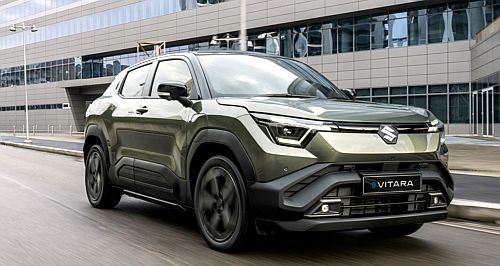 Read more5th of January 2026  Suzuki Fronx scores one ANCAP starComponent failure, poor crash test performance earns Fronx weak one-star ANCAP score26th of November 2025  Suzuki Jimny 3-Door to return in 2026Extra safety equipment marks return of refreshed Suzuki Jimny 3-Door from FebruaryAll future modelsVitara pricing
Motor industry news GoAutoNews is Australia’s number one automotive industry journal covering the latest news, future and new model releases, market trends, industry personnel movements, and international events. |
Click to shareSuzuki modelsResearch Suzuki All future modelsVitara pricing
Motor industry newsGoAutoNews is Australia’s number one automotive industry journal covering the latest news, future and new model releases, market trends, industry personnel movements, and international events. |


 Alfa Romeo
 Abarth
 Audi
Audi Aston Martin
 BMW
BMW Bentley
 Ferrari
 Chevrolet
 Ford
Ford Fiat
Fiat GWM
GWM Foton
Foton Hyundai
 Honda
Honda Jaguar
 Isuzu
Isuzu Kia
Kia Jeep
Jeep Land Rover
 Lamborghini
 Maserati
 Lexus
Lexus McLaren
 Mazda
Mazda MG
MG Mercedes-Benz
 Mitsubishi
 Mini
Mini Peugeot
 Nissan
 Ram
Ram Porsche
 Rolls-Royce
 Smart
Smart Skoda
Skoda Suzuki
 Subaru
 Toyota
 Tesla
Tesla Volvo
Volvo Volkswagen
 Zeekr
Zeekr

Connect with us


Facebook Twitter Instagram