

Make / Model Search
OptionsCar reviews - JAC - HunterJAC modelsOverviewWe like Potent powertrain, solid off-road capability, sub-$50K pricing, pleasant interior materials, strong towing and payload capacity, solid cabin UX and UI Room for improvement Noticeable tyre and wind noise, noisy engine; firm ride; vague steering; disappointing fuel economy JAC’s sharply-priced Hunter PHEV is poised to shake up the plug-in hybrid ute space.8 May 2026 Overview
THE JAC Hunter PHEV is the latest entrant into the ever-growing plug-in hybrid ute space, poised to do battle with the BYD Shark 6, GWM Cannon Alpha PHEV, and the Ford Ranger Hybrid.
Not only is JAC’s latest offering targeting the plug-in hybrid market, but the Chinese importer has pitched the Hunter PHEV as an electrified alternative to traditional diesel ute models to coax buyers away from the likes of the Toyota HiLux, Isuzu D-Max, Mitsubishi Triton and the non-hybrid Ford Ranger.
The Hunter PHEV dual cab range will comprise two variants in Australia: the Pro and the X models. However, a cab chassis model is also expected in the near future.
Pricing is yet to be fully confirmed at the time of writing, but JAC says the Hunter PHEV will start from “under $50,000” before on-road costs.
From May 5, customers can reserve a JAC Hunter PHEV for a fully refundable $1000, with the first 1000 customers to place a reservation and take delivery receiving either a home EV charger or a $500 JAC genuine accessories voucher.
Compared to the best-selling plug-in hybrid ute in Australia, this makes the JAC Hunter PHEV at least $5900 cheaper than the entry-level BYD Shark 6 Cab-Chassis model ($55,900 +ORCs) and $7900 cheaper than the entry-level dual-cab model ($57,900 + ORCs). It’s also less than the entry-level GWM Cannon Alpha PHEV (priced from $54,490 drive away until May 31, 2026) and the currently on run-out Ford Ranger Hybrid (from $62,000 drive away as of April 1, 2026).
A full list of standard and optional features for both the Hunter Pro and X variants are yet to be revealed by JAC.
What we do know is that the Pro model will come with chrome exterior elements and a leather-accented interior – complete with black quilting and black stitching – while front and rear differential locks will be available as an optional extra.
As for the range-topping X, this model will come with front and rear differential locks as standard, black exterior elements, and red accent stitching in the interior. A sunroof is available as an optional extra.
The show car unveiled at the 2025 Melbourne Motor Show was also equipped with a 10.4-inch portrait infotainment touchscreen with Apple CarPlay and Android Auto compatibility, as well as a 10.25-inch digital instrument cluster.
Whether the 10.25-inch digital instrument cluster – as opposed to the seven-inch unit found on the T9 – makes it to full production remains to be seen.
Autonomous emergency braking, adaptive cruise control with stop and go, and a 360-degree camera have also previously been listed as part of the Hunter’s safety suite.
Based off the testing scores of its T9 stablemate – which was tested under 2024 protocols – the Hunter PHEV has been awarded a five-star ANCAP safety rating
The Hunter is the plug-in hybrid version of the diesel-powered T9 ute that launched in Australia in 2024.
When GoAuto reviewed the T9 back in March 2025, we praised the ute for its sharp pricing but criticised it for its relatively poor driving experience.
However, the Hunter PHEV might be able to solve at least some of its diesel-powered sibling’s problems. By the time customer cars go on sale in the middle of this year, the Hunter PHEV will have racked up over 50,000km of local testing.
Its powertrain comprises a 2.0-litre turbocharged petrol engine, a dedicated hybrid transmission and dual electric motors – sourcing electricity from a 31.2kWh lithium-iron phosphate battery which supports 3.3kW vehicle-to-load functionality) – for a combined system output of 360kW.
JAC is yet to quote an official combined torque output, but the internal combustion engine produces 370Nm while the front and rear electric motors generate 300Nm and 340Nm respectively.
Claimed fuel economy is 1.6 litres per 100km on the NEDC cycle and combined range is quoted at up to 1005km.
The Hunter PHEV has a braked towing capacity of 3500kg regardless of the state of charge and a 915kg payload.
When it comes to the ownership prospect, the Hunter PHEV will be offered with a seven-year unlimited kilometre warranty, 24/7 roadside assist, and a ute-for-ute vehicle warranty loan program.
A seven-year capped price servicing program will also be offered for the Hunter PHEV, although service intervals and pricing will be revealed closer to its official sales start.
While the Hunter PHEV is yet to hit Australian showrooms, GoAuto got behind the wheel of pre-production examples at JAC’s preview drive day event.
Driving Impressions
It is important to note that the pre-production JAC Hunter PHEV examples we drove will not be entirely representative of the vehicles customers will be able to buy.
According to JAC, final software and system integration is still ongoing and the utes we drove were not up to the latest local tuning specification.
Specifically, we had the opportunity to test the range-topping X model.
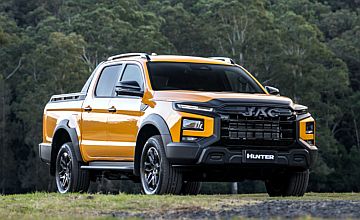
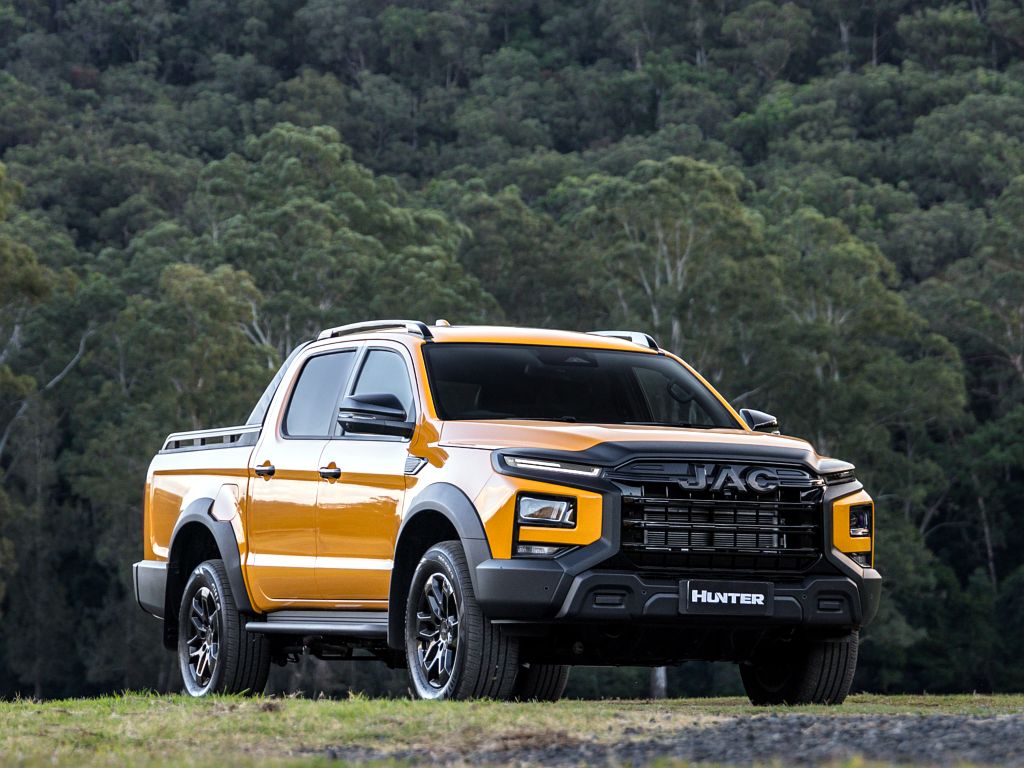
From the outside, the Hunter PHEV is largely identical to its T9 stablemate save for its more reserved sailplane design.
Inside, things are basically the same too. Not that this is a bad thing of course, as we found the interior fit and finish to be one of the T9’s strengths. In the Hunter PHEV, the leather, faux metal and plastics feel pleasant to interact with.
The cockpit’s usability and amenities are strong too, with a slick and simply-laid-out infotainment touchscreen, physical controls for the fan speed, air conditioning temperature, and window demisting, and access to USB-A and USB-C ports, a 12V socket and a wireless phone charger.
Front row storage options include a relatively small air conditioned centre console armrest storage and door bins but decently-sized cupholders.
From the driver’s seat, forward visibility is strong although rear visibility is slightly limited due to the Hunter PHEV’s small rear window but its large wing mirrors make up for this.
In the second row, both headroom and knee room are good although with very little room for your feet under the front seats it’s quite difficult to stretch your legs out, leaving you with little under-thigh support and making it difficult to really get comfortable.
When it comes to amenities, backseat passengers are as equally well accounted for as front-row occupants, with access a centre folding armrest with cupholders, rear air vents, back seat storage pockets, USB-A and USB-C ports, a 220V power plug, and (albeit small) door bin storage. Our road driving time in the JAC Hunter PHEV was limited to a short loop on Peats Ridge Road, a fast regional road nestled in the New South Wales Central Coast.
The powertrain makes an immediate impression. Its 360kW progresses the Hunter PHEV briskly up the road and is reasonably responsive in the process.
The 2.0-litre turbocharged internal combustion engine does get quite vocal though, especially when recharging the plug-in hybrid battery, and the transmission seems to make some noise too with considerable whine.
It’s difficult to draw a truly representative fuel number from such a short drive, although two different Hunter PHEV’s on highway tyres and Pirelli Scorpion All Terrain Plus tyres and on the same road loop returned 50km average fuel consumption figures of 10.7 litres and 9.6 litres per 100km respectively.
These vehicles were both driven using the standard regenerative braking mode and the Auto drive mode for the powertrain.
In pre-production form, the Hunter PHEV also seems unable to shield its occupants from the considerable wind and tyre noise that afflicts its T9 stablemate.
We didn’t get to assess much of the Hunter PHEV’s cornering ability although the steering did feel a bit light and somewhat vague. The suspension is also noticeably firm and although this is hardly unexpected for an unladen ute, it didn't exactly feel refined.
When it comes to ADAS, the warning systems stay quiet, and the adaptive cruise control works as expected. However we did find the lane departure warning a tad overactive and its accompanying beep somewhat irritating.
We also had the opportunity to test the Hunter PHEV off-road.
While the off-road course we were faced with wasn’t the world’s most challenging, the Hunter PHEV handled itself confidently and performed particularly well on steep inclines. We suspect it will meet most of its prospective customer’s off-road requirements.
Unsurprisingly, the pre-production JAC Hunter PHEV is a little rough around the edges, with light, vague steering, a ride that is arguably too firm, and noticeable wind, tyre, and mechanical noise.
However, money talks. A sub-50 grand plug-in hybrid ute is an undeniably appealing prospect, especially one with such a potent powertrain, a 3.5-tonne towing capacity, and a 915kg payload.
Should production-ready examples be able to reap the full benefits of the Hunter PHEV’s 50,000km local testing program, then JAC’s new electrified offering could represent a very complete package.
However, we’ll have to wait until its full pricing reveal to assess the JAC Hunter PHEV’s true value.
 Read more17th of April 2026  JAC Hunter PHEV makes timely arrivalPlug-in hybrid JAC Hunter arrives ‘just in time’ to capitalise on rising diesel prices23rd of February 2026  JAC PHEV ute undergoes pre-launch testingPlug-in hybrid JAC Hunter ute with 385kW/1000Nm 4x4 driveline here by mid-year |
OptionsClick to share
|


 Alfa Romeo
 Abarth
 Audi
Audi Aston Martin
 BMW
BMW Bentley
 Ferrari
 Chevrolet
 Ford
Ford Fiat
Fiat GWM
GWM Foton
Foton Hyundai
 Honda
Honda Jaguar
 Isuzu
Isuzu Kia
Kia Jeep
Jeep Land Rover
 Lamborghini
 Maserati
 Lexus
Lexus McLaren
 Mazda
Mazda MG
MG Mercedes-Benz
 Mitsubishi
 Mini
Mini Peugeot
 Nissan
 Ram
Ram Porsche
 Rolls-Royce
 Smart
Smart Skoda
Skoda Suzuki
 Subaru
 Toyota
 Tesla
Tesla Volvo
Volvo Volkswagen
 Zeekr
Zeekr

Connect with us


Facebook Twitter Instagram