

Make / Model Search
OptionsCar reviews - Toyota - HiluxToyota modelsOverviewWe like Improved handling and response; slightly calmer ride; significant uptick in tech and safety; no loss of off-road, towing, or hauling capabilities Room for improvement Divisive exterior styling; familiar cabin and tub compromises; electric steering too light for most tastes; wide body and GR Sport variants deleted Worthwhile changes headline the arrival of Toyota’s ninth generation Toyota HiLux range11 Dec 2025 By MATT BROGAN Overview
THE ‘new’ Toyota HiLux is essentially a deep revision of the eighth-generation model range featuring a familiar chassis, cabin, driveline, tub, and a majority of the same specifications.
Yet, there is enough ‘new’ here to keep HiLux buyers interested, particularly where driveability, comfort, technology, and safety are concerned.
Reduced from 23 variants to 16, the HiLux range does away with the 2.7-litre four-cylinder petrol and turbocharged 2.4-litre four-cylinder diesel engines in favour of the carryover turbocharged 2.8-litre four-cylinder diesel.
Now running AdBlue and with the choice of six-speed manual or automatic transmissions, this is the only driveline available – at least until the battery electric alternative arrives next year (2026).
Resultantly, the entry price of the HiLux range jumps by more than $6000 (now from $33,990 plus on-road costs), while like-for-like prices rise between $1020 and $5025 depending on grade. See our full pricing story here.
Manual transmission variants make 150kW/420Nm while the automatic delivers 150kW/500Nm. Toyota’s V-Active 48-volt mild hybrid technology is available in higher grade auto variants.
Electric power steering takes the place of the previous ute’s hydraulic configuration while HiLux is now offered with two distinct suspension tunes – a heavier-duty set-up for WorkMate and SR, or comfort-orientated spring rates and stroke for higher tiers.
All grades continue to use a leaf-sprung rear.
Variants with four-wheel drive also continue to sport a part-time system with dual-range transfer case rather than an ‘auto’ 4WD set-up, while a disc/drum brake combination is offered lower in the model walk.
Familiar grades continue, with price-leading WorkMate offering a choice of 4x2 (single and double cab-chassis formats) or 4x4 (adding a double cab pick-up). SR alone retains a cult-favourite extra-cab shape, while SR5 continues to offer the option of a double cab-chassis alongside the double cab pick-up.
A double-flagship strategy sees the Rogue nameplate retained while the Rugged X badge returns at the same price. The GR Sport has been discontinued for now.
Standard across the range are safety features including autonomous emergency braking, adaptive cruise control, lane trace assist and departure warning, speed sign recognition, blind spot monitoring, rear cross-traffic alert and a reversing camera.
All new-gen HiLux models have integrated SOS emergency calling, vehicle insight and auto collision notification functionality for as long as the 4G phone network is available.
Other connectivity features, within the Toyota Connect+ and Multimedia Connect suites, are complimentary for the first 12 months of ownership but are only available via paid subscription after that point.
Warranty, roadside assistance, and capped-price servicing programs remain largely unchanged.
With full model-by-model specifications are available here, it is the drive of the ninth-generation HiLux we’ll focus on below, noting worthwhile changes that help keep the HiLux in step with rivals that include Ford Ranger/Volkswagen Amarok, Isuzu D-Max/Mazda BT-50, and Mitsubishi Triton/Nissan Navara pairings.
Driving Impressions
It might have a face only a mother could love, but the ‘new’ Toyota HiLux offers enough differentiation elsewhere to ensure return buyers won’t be disappointed by the upgrade.
In addition to the specification, equipment, and technology updates already noted, it’s the HiLux’s carry-over strengths – and incremental chassis and driveline improvements – that are certain maintain its appeal.
Most appreciable to this current generation HiLux owner is the improved handling and turn-in response on offer in the ninth-gen model. Sharper reflexes and flatter cornering combine with a slightly calmer ride that helps the HiLux feel more stable than it did before.
While we wouldn’t say it’s more comfortable per se, it is more confident in cornering – both on and off the beaten track. Yes, the steering is lighter than before (almost too light in its Normal setting), but it is still with proper feedback, ensuring the driver has a good sense of what’s happening down below.
We did not get to sample the HiLux with a load in the tray, or with a trailer in tow. But we did spend a significant portion of the media drive on rugged off-road tracks, showcasing the formidable off-road traction system and no-nonsense four-wheel drive that has for generations been a star of the HiLux show.
Severe cross-axle loads quickly demonstrate just how well the HiLux can gain traction and go, the four-wheel drive system showing very little wheel slip, and keeping momentum with no more than a steady throttle.
With the 2.8-litre turbo-diesel engine now standard across the range, you could be forgiven for thinking there is little to separate the various HiLux grades. But there is a very clear difference when driving the manual and automatic, and the V-Active equipped models back-to-back that the specification sheet might not make clear.
The manual, though down on torque compared with the automatic, offers plenty of get-go from low in the rev range, and is linear in its response across the tacho. Unladen, it offers very little performance deficit against the automatic, feeling rather energetic and entirely well matched to its six forward ratios.
By contrast, the automatic feels less spirited where step-off acceleration is concerned, preferring to get underway before accelerating with any real purpose. That said, it is evident the auto has more torque when climbing extended grades, requiring fewer downshifts to achieve the same result – and being comparable where fuel use is concerned.
But it’s the V-Active grades that take the performance (and economy) win. The additional step-off torque helps fill the gap before the turbocharger takes over, a benefit not only evident from a standstill, but also when rolling on from roundabouts, or when moving from cruising- to overtaking speeds.
Against the needle, the V-Active also proved around 1.2L/100km more efficient than the non-hybridised duo, hovering contently in the 9.0-litre range throughout the mixed conditions sampled.
Now while there’s really very little about the driveline that is not already obvious in the current generation range, it is impressive to note that the mechanical noise and vibration is a touch improved. There’s less quivering felt through the footboard at idle and less diesel chatter heard underload.
Unfortunately, Toyota has not addressed the wind noise evident around the wing mirrors – that oversight certain to cost the HiLux buyers who might sample the vehicle against the quieter Ranger or Amarok, for example.
But there are other issues that place the HiLux behind those particular rivals, too. The cabin remains on the smaller side, the wider console in particular chewing into knee room at the front of house.
The higher bonnet is harder to see over when climbing off-road, and the tub is, well, the same as before, meaning too few tie-down points and dimensions that feel less generous than others in the class.
And it’s those familiar sticking points – coupled with those God-awful frontal looks – that we reckon might make HiLux buyers think twice before upgrading. As worthwhile as the improvements Toyota has made might be, they don’t really go far enough at keeping the HiLux ahead of the pack.
Given we’re stuck with the now-new HiLux for another decade, it’s conceivable that Toyota’s much-loved ute will struggle to keep its place at the head of the pack – even if it is as reliable and unbreakable as Toyota claims it to be. 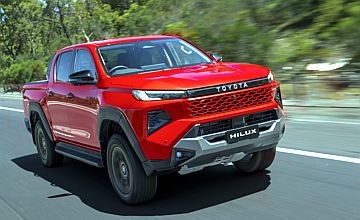 Read more9th of December 2025  Toyota addresses HiLux styling criticismEV led ‘Cyber Sumo’ design divides HiLux buyer opinion, but Toyota says its ‘future proof’9th of December 2025  HiLux BEV ‘a start’ for electric light commercialsToyota Australia recognises limitations of electric HiLux, but says ‘we have to make a start’9th of December 2025  New Toyota HiLux: What changed beyond looks?We take an in-depth look at the differences between the new and outgoing HiLux ranges8th of December 2025  Market Insight: Toyota exceeds sales forecastsToyota ups annual sales forecast by 15K units despite runout of HiLux and RAV412th of November 2025  Just 240km range likely for new Toyota HiLux BEVSmall 59kWh battery for diesel-like payload impacts HiLux BEV’s driving range12th of November 2025  Up to $6K price increase for new-gen Toyota HiLuxFewer variants, single diesel engine offering for pricier new-gen Toyota HiLux ute |
OptionsClick to share
|


 Alfa Romeo
 Abarth
 Audi
Audi Aston Martin
 BMW
BMW Bentley
 Ferrari
 Chevrolet
 Ford
Ford Fiat
Fiat GWM
GWM Foton
Foton Hyundai
 Honda
Honda Jaguar
 Isuzu
Isuzu Kia
Kia Jeep
Jeep Land Rover
 Lamborghini
 Maserati
 Lexus
Lexus McLaren
 Mazda
Mazda MG
MG Mercedes-Benz
 Mitsubishi
 Mini
Mini Peugeot
 Nissan
 Ram
Ram Porsche
 Rolls-Royce
 Smart
Smart Skoda
Skoda Suzuki
 Subaru
 Toyota
 Tesla
Tesla Volvo
Volvo Volkswagen
 Zeekr
Zeekr


Connect with us


Facebook Twitter Instagram