


Make / Model Search

News - JAC50:50 split expected for JAC T9 and Hunter PHEVJAC expects an even volume split between diesel and PHEV utes, balancing NVES scales8 May 2026 JAC Motors Austraia said an expected 50:50 sales volume split between the JAC T9 diesel ute and the inbound Hunter Plug-In Hybrid will greatly help its New Vehicle Efficiency Standard (NVES) position.
Like every car manufacturer in Australia, JAC must meet the requirements of NVES emissions regulations introduced in January 2025.
The JAC T9 is classed as a Light Commercial Vehicle or a Type 2 Vehicle under the NVES regulations, meaning under 2026 standards it must emit on average 180 grams of CO2 per kilometre or less to avoid incurring NVES penalties.
However, the T9 is rated at a non-compliant 202g/km, but JAC is confident it can balance the NVES scales with its low emissions Hunter PHEV according to its local director of technical and Product Hongjian Jiang.
“The CO2 emissions on the NEDC testing cycle for the PHEV is 38 grams per kilometre. It’s very low. So, we will be in a very good position to balance the T9 diesel,” he told GoAuto at a recent preview drive for the Hunter PHEV in NSW.
Save for the BYD Shark 6 Performance – for which the brand quotes its WLTP test figure of 23 grams per kilometre – the JAC Hunter PHEV’s carbon emissions are the lowest in Australia’s plug-in hybrid ute segment.
For reference, the cab-chassis and non-performance dual cab variants of the BYD Shark 6 are rated at 46g/km on the NEDC cycle.
Meanwhile, the Ford Ranger PHEV emits 66g/km while the GWM Cannon Alpha PHEV emits 39g/km.
JAC Motors Australia managing director Ahmed Mahmoud said he is expecting a 50:50 volume split between the diesel-powered T9 and the plug-in hybrid Hunter, although production remains flexible enough to accommodate a vast majority of either powertrain.
“If it’s 100 per cent diesel or 100 per cent hybrid, the factory is agile enough to be able to accommodate what we need here in Australia,” he said.
“But I would say it will settle to a point where we’d be around 50:50.
“At launch, because there’s going to be your natural early adopters that jump on board, I think you’ll find the ratio will be more in favour of the Hunter before it settles out, because there are still plenty of customers out there that need a diesel ute and (for whom) electrification or plug-in (hybrid technology) just doesn't work for.”
The proposed 50:50 volume split seems to contradict trends in the wider Australian automotive industry.
While the PHEV space has grown dramatically in recent years, the technology still holds a relatively small market share compared with vehicles powered solely by internal combustion.
According to the latest available data on the Australian Automobile Association’s Electric Vehicle Index, 64.23 per cent of new vehicle sales so far in 2026 are ICE-powered only, while plug-in hybrids make up 6.82 per cent of all new vehicles sold.
Looking at 4WD utes, ICE-powered models make up just shy of 90 per cent of new vehicle sales while plug-in hybrids take up 9.55 per cent.
The leading success story when it comes to plug-in hybrid ute sales is unquestionably the BYD Shark 6.
With 18,073 examples sold in 2025, the Shark 6 was the best-selling plug-in hybrid ute in Australia, but also the best-selling PHEV regardless of segment and the 18th best-selling vehicle overall.
Since its Australian arrival back in 2024, just shy of 2000 examples of the JAC T9 diesel ute have been sold on local shores.
When the Hunter PHEV goes on sale in the middle of this year, the range will comprise the entry-level Pro and the range-topping X variants, with pricing starting “under $50,000” before on-road costs.
A cab-chassis variant of the Hunter PHEV is also expected in the near future.
This pricing is likely to make the Hunter PHEV the cheapest plug-in hybrid ute on sale in the Australian market.
With an exact figure yet to be revealed, it remains unclear precisely where it will sit relative to its T9 stablemate, which is currently available from $38,990 + ORCs. 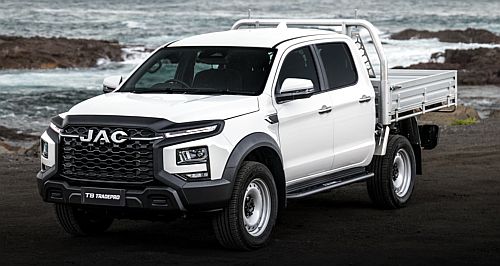 Read more8th of May 2026  2026 JAC Hunter PHEV Pre-Production DriveJAC’s sharply-priced Hunter PHEV is poised to shake up the plug-in hybrid ute space.7th of May 2026  JAC Hunter PHEV pricing teasedJAC’s electrified Hunter ute will start from below $50K, but exact pricing remains elusive9th of April 2026  BYD Shark 6 PHEV ute range expandsCab-Chassis and Performance models join BYD Shark 6 range alongside Premium variant23rd of February 2026  Market Insight: NVES debut winners and losersBYD, Toyota, Tesla notch up the most NVES credits as Mazda, Nissan, Subaru lag behind9th of February 2026  2026 Ford Ranger Wildtrak PHEV ReviewWe take a deep dive into the realities of living with a plug-in hybrid dual-cab ute |
Click to shareJAC articlesMotor industry news GoAutoNews is Australia’s number one automotive industry journal covering the latest news, future and new model releases, market trends, industry personnel movements, and international events. |



Connect with us


Facebook Twitter Instagram